
Why Is My Pool Water Cloudy? Common Causes & Fixes for Lexington, SC Homeowners
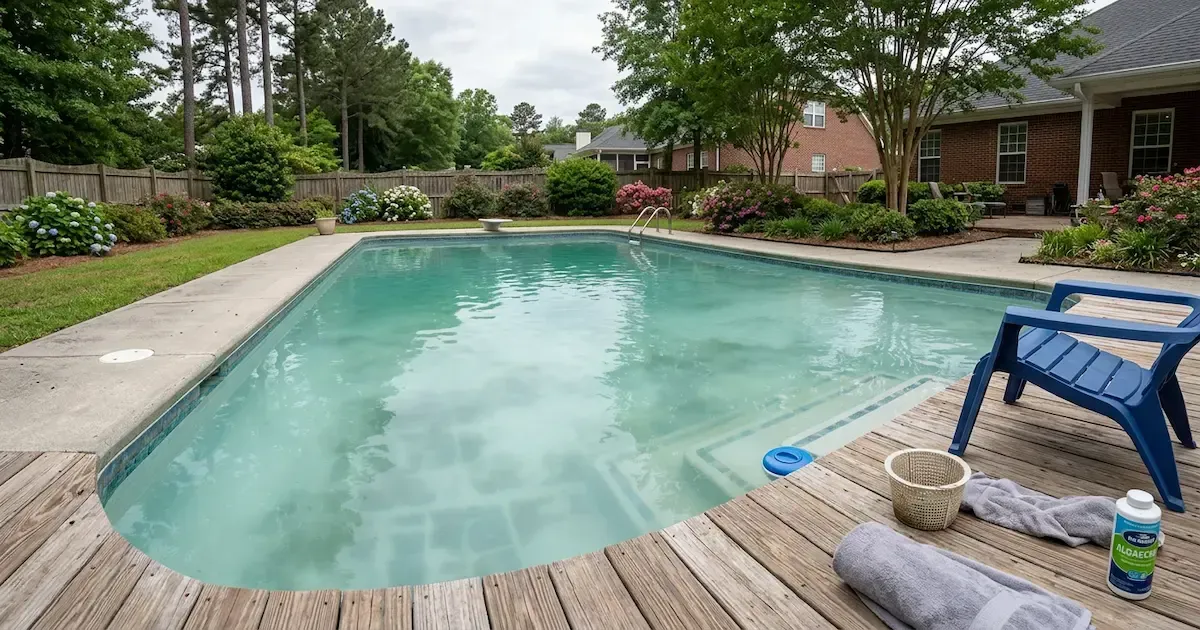
You step outside, look at your pool, and something's off. The water that was crystal clear two days ago is now hazy — maybe milky white, maybe a dull gray-blue. You can't see the bottom. You're not sure if you should let your kids swim in it.
Cloudy pool water is the single most common complaint we hear from Lexington-area homeowners in the summer months. And it makes sense — South Carolina heat is relentless, pools get heavy use, afternoon storms roll through, and the conditions that cause water chemistry to go sideways are everywhere from June through August.
The good news: cloudy water is fixable. But you need to know why it's cloudy before you start dumping chemicals in — because the wrong fix can make it worse.
Here's what to check.
The Most Common Causes of Cloudy Pool Water
1. Low or Depleted Chlorine
This is the #1 culprit in summer. Chlorine does the heavy lifting in your pool — it kills bacteria, breaks down organic matter, and keeps algae from taking hold. But South Carolina's UV intensity burns through chlorine faster than most homeowners realize. Add a heavy bather load on a hot weekend, and you can go from balanced to depleted in a matter of days.
When chlorine drops too low, the water turns cloudy almost immediately. If you haven't tested in a week or more, start here.
Target chlorine level: 1–3 ppm free chlorine
2. pH Is Out of Range
pH affects everything in your pool. When it drifts too high (above 7.8), chlorine becomes dramatically less effective — even if the numbers look fine on a test strip. High pH also causes calcium to precipitate out of the water, which creates that characteristic white haze.
When pH drops too low (below 7.2), the water becomes corrosive and can cause its own set of problems, including eye irritation and equipment damage.
Target pH range: 7.4–7.6
3. Poor Filtration or a Dirty Filter
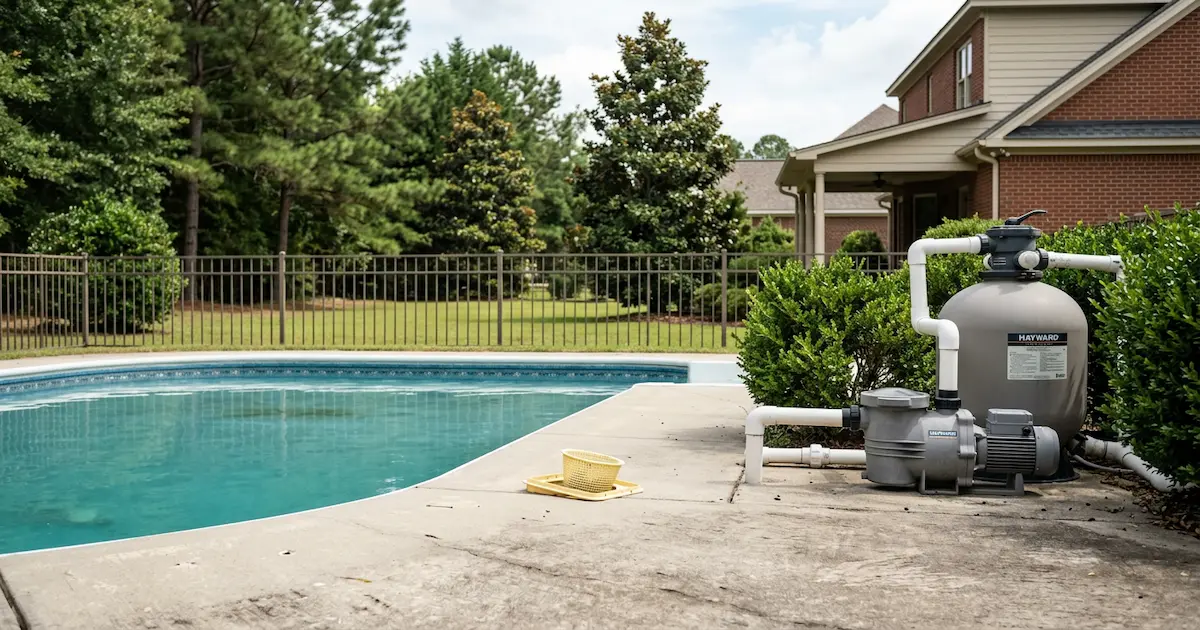
Your filter is responsible for physically removing particles from the water. When it's clogged, dirty, or undersized for your pool's volume, those particles stay suspended — and the water turns hazy.
Check how long your pump is running each day. In summer, most pools in the Midlands need 8–12 hours of daily filtration to stay clear. If you've been running it for 4–6 hours, that's likely part of the problem.
Also, check your filter pressure gauge. If it's reading 8–10 psi above normal, the filter needs to be backwashed or cleaned.
4. Heavy Rain or Runoff
South Carolina summer storms are intense and frequent. When a heavy rain hits, it introduces a flood of contaminants into your pool — pollen, dirt, lawn chemicals, organic debris, and massive amounts of phosphates. All of that throws off your water chemistry fast.
Cloudy water after a storm is extremely common here in the Lexington and Columbia area. If your pool looked fine before the last thunderstorm and hazy after, the storm is almost certainly the trigger. The fix is retesting and rebalancing your full chemistry panel — not just dumping in chlorine.
5. High Bather Load
A pool party on a 95-degree Saturday does a number on your water. Every person who gets in brings sunscreen, sweat, body oils, and other organics that consume chlorine rapidly. Combined compounds — called chloramines — build up and cause that hazy, irritating water that also smells strongly of chlorine (counterintuitively, that smell means your chlorine is actually bound up and not working).
The fix here is a shock treatment — a heavy dose of chlorine that breaks apart those combined compounds and restores free chlorine to effective levels. After a big pool day, shocking the water that evening is good practice.
6. High Calcium Hardness or Total Dissolved Solids
Over time, as water evaporates and is replaced, minerals and dissolved solids build up in the water. When calcium hardness gets too high (above 400 ppm), it causes a persistent white cloudiness that doesn't respond to chlorine or pH adjustments. This is more common with older pools or pools that haven't had a partial drain and refill in several years.
This one requires a water test beyond the basic strips — a full chemical analysis will catch it.
Where to Start: A Simple Troubleshooting Order
If your pool is cloudy right now, here's the sequence to follow:
1. Test your water — get a full reading on pH, chlorine, alkalinity, calcium hardness, and cyanuric acid
2. Adjust pH first — get it in range before adding chlorine (out-of-range pH makes chlorine ineffective)
3. Shock the pool — use a quality pool shock and let it run overnight with the pump going
4. Check and clean your filter — backwash if it's a sand filter, rinse if it's a cartridge
5. Run the pump longer — 10–12 hours minimum until water clears
6. Retest in 24 hours — chemistry needs time to stabilize; don't keep adding product before checking results
If you've gone through all of that and the water is still hazy after 48 hours, something deeper is going on — and that's when it's time to call a professional.
When It's Time to Call Palmetto Pool Solutions
Some cloudy water situations are simple chemistry tweaks. Others involve underlying filtration problems, plumbing issues, or water chemistry so far out of balance that DIY treatments keep falling short.
At Palmetto Pool Solutions, we diagnose the actual cause — not just treat the symptom. We're CPO-certified, fully insured, and licensed, and we know Lexington-area pool conditions inside and out. A cloudy pool in July doesn't have to mean a wasted summer weekend.
Whether you need a one-time treatment or consistent weekly maintenance to keep your water clear all season, we're a phone call away.
Contact Palmetto Pool Solutions today — we'll get your water clear and keep it that way.
Palmetto Pool Solutions proudly serves Lexington, West Columbia, Irmo, Chapin, Gilbert, and the surrounding Midlands area.